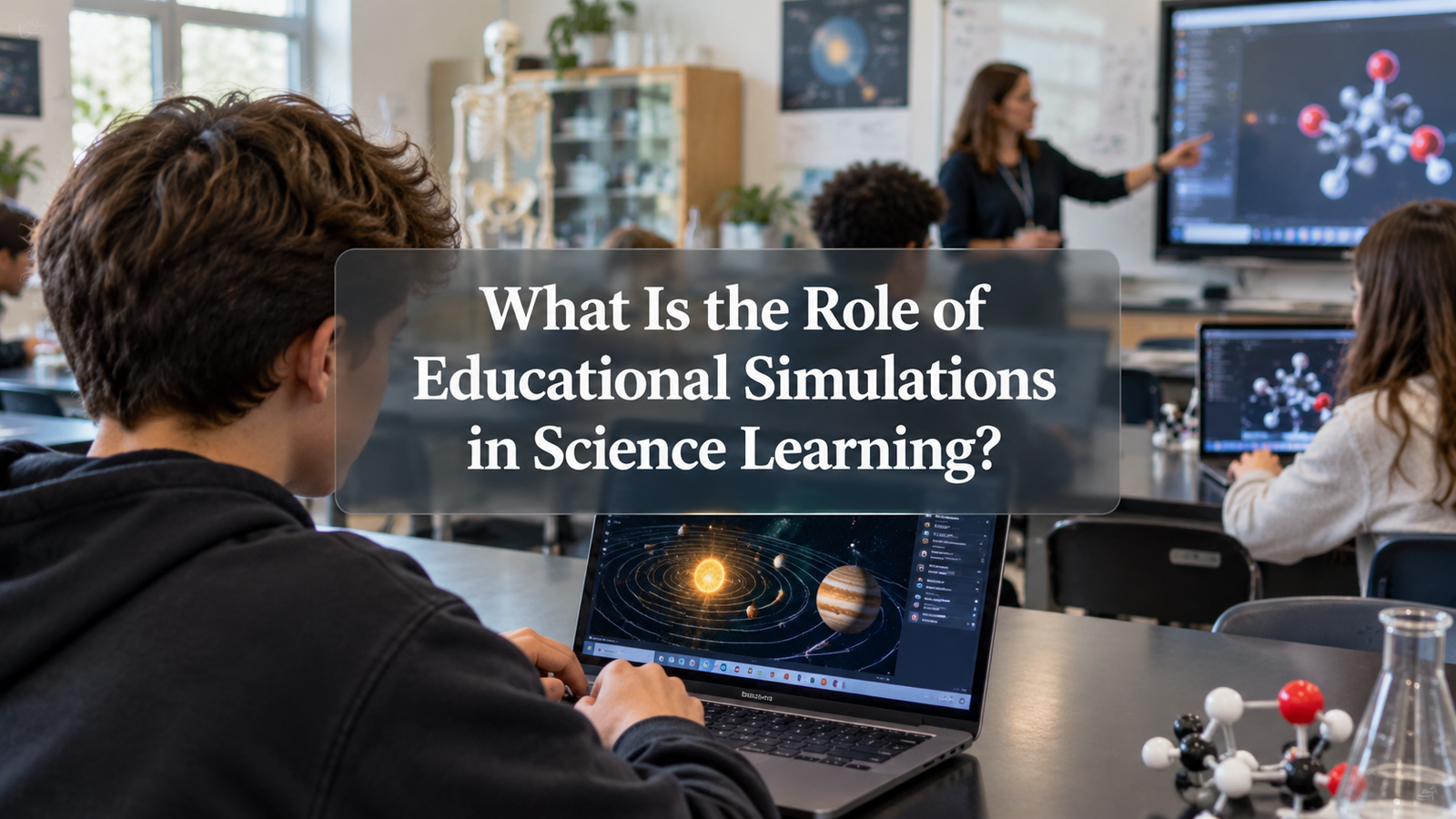
Science is an important subject because it helps students understand the natural world and the processes that shape everyday life. From the movement of planets to the structure of living cells, science explains many things that people observe around them. However, learning scientific concepts through textbooks and classroom lectures can sometimes be difficult. Many scientific processes are complex, and students may struggle to understand them without practical examples.
Educational simulations have become a useful part of modern science education. They allow students to explore scientific ideas through interactive digital environments. Instead of simply reading about an experiment, students can observe how it works, change different conditions, and examine the results.
The role of educational simulations in science learning is to make complicated concepts easier to understand while encouraging curiosity, experimentation, and active participation. These learning tools can help students connect scientific theories with practical situations.
What Are Educational Simulations in Science Learning?
Educational simulations are digital learning tools that represent real scientific processes, experiments, or situations. They use computer programs, animations, interactive models, and visual demonstrations to help students understand scientific principles.
For example, a physics simulation may allow students to change the speed of an object and observe how its movement changes. A chemistry simulation might demonstrate how different substances react under specific conditions. Similarly, a biology simulation can show how blood circulates through the human body.
These simulations create opportunities for students to explore scientific ideas in a controlled virtual environment.
Unlike traditional videos, many educational simulations allow learners to interact with the content. Students can adjust variables, repeat experiments, and compare different results.
This interactive approach makes science learning more engaging and encourages students to develop a deeper understanding of the subject.
Why Are Educational Simulations Important in Science Education?
Science education involves more than remembering definitions and scientific facts. Students also need to understand relationships, investigate problems, and develop logical explanations.
Educational simulations support these learning goals by giving students opportunities to observe scientific processes directly.
Some scientific experiments are difficult to perform in ordinary classrooms because they require expensive equipment, special facilities, or complicated safety arrangements.
For example, students cannot easily observe the movement of electrons inside an atom or examine the internal structure of the Earth.
Digital simulations can represent these processes visually and help students understand how they work.
They also allow teachers to present scientific concepts in ways that are easier for students to follow.
When educational simulations are combined with classroom explanations and practical activities, they can make science lessons more meaningful and effective.
1. Making Complex Scientific Concepts Easier to Understand
One of the most important benefits of educational simulations in science learning is their ability to simplify complicated topics.
Students often find abstract scientific concepts difficult because they cannot observe them directly.
For example, understanding electric circuits through diagrams alone may be challenging for beginners.
An interactive simulation can show how a circuit operates when different components are connected.
Students can add batteries, switches, and bulbs to examine how changes affect the circuit.
This visual experience helps learners connect scientific explanations with observable results.
Educational simulations are particularly useful when teaching subjects that involve movement, invisible processes, or relationships between multiple variables.
By presenting information visually, simulations can help students develop clearer mental models of scientific concepts.
2. Encouraging Active Participation in Science Lessons
Traditional classroom teaching sometimes involves students listening to explanations while taking notes.
Although this method can provide useful information, students may have limited opportunities to explore scientific questions independently.
Educational simulations encourage active participation by allowing learners to interact with scientific models.
Instead of watching an experiment without involvement, students can make decisions and observe their consequences.
For example, students learning about plant growth can use a simulation to change sunlight, water availability, and temperature.
They can then observe how these conditions influence plant development.
Such activities encourage learners to ask questions and investigate possible explanations.
Active participation can also make science lessons more interesting because students become directly involved in the learning process.
3. Providing a Safe Environment for Scientific Experiments
Some scientific experiments involve risks that make them unsuitable for inexperienced students.
Chemistry laboratories may contain reactive substances, while physics experiments can involve electricity, heat, or moving equipment.
Educational simulations provide a safer environment in which students can explore these situations without exposure to physical hazards.
For example, a chemistry simulation can demonstrate reactions involving substances that would require special precautions in a real laboratory.
Students can observe the process, investigate possible outcomes, and understand the underlying scientific principles.
This approach is especially useful for introducing laboratory procedures before students perform practical experiments.
However, virtual experiments should not completely replace real laboratory experience.
Students still need opportunities to develop practical skills, understand laboratory safety, and learn how to handle scientific equipment responsibly.
4. Supporting Learning Through Trial and Error
Scientific discovery often involves testing ideas, examining results, and improving explanations.
Educational simulations support this process because students can repeat experiments without wasting physical materials.
When learners make an incorrect prediction, they can adjust the conditions and try again.
For example, students studying forces and motion can change the mass of an object or the force applied to it.
They can observe how these adjustments influence acceleration and compare the results with their predictions.
This process helps students recognize mistakes as opportunities for learning.
Repeated experimentation can also improve understanding because learners discover relationships through observation rather than memorization alone.
With proper teacher guidance, educational simulations can encourage persistence and a more investigative approach to science.
5. Improving Scientific Problem Solving Skills
Problem solving is an essential part of science education.
Students must learn how to identify questions, gather information, evaluate evidence, and develop reasonable conclusions.
Educational simulations provide opportunities to practice these skills through interactive scientific situations.
For example, a simulation involving environmental pollution might ask students to investigate why water quality is declining in a particular area.
Learners could examine different pollution sources and test possible solutions.
They would need to compare evidence and consider which factors influence the results.
These activities encourage logical thinking and help students understand that scientific problems often involve several connected variables.
When simulations are designed around meaningful questions, they can strengthen students’ ability to approach unfamiliar scientific challenges.
6. Helping Students Visualize Invisible Scientific Processes
Many important scientific processes cannot be observed directly with the human eye.
Examples include molecular movement, cellular functions, electromagnetic fields, and the movement of particles.
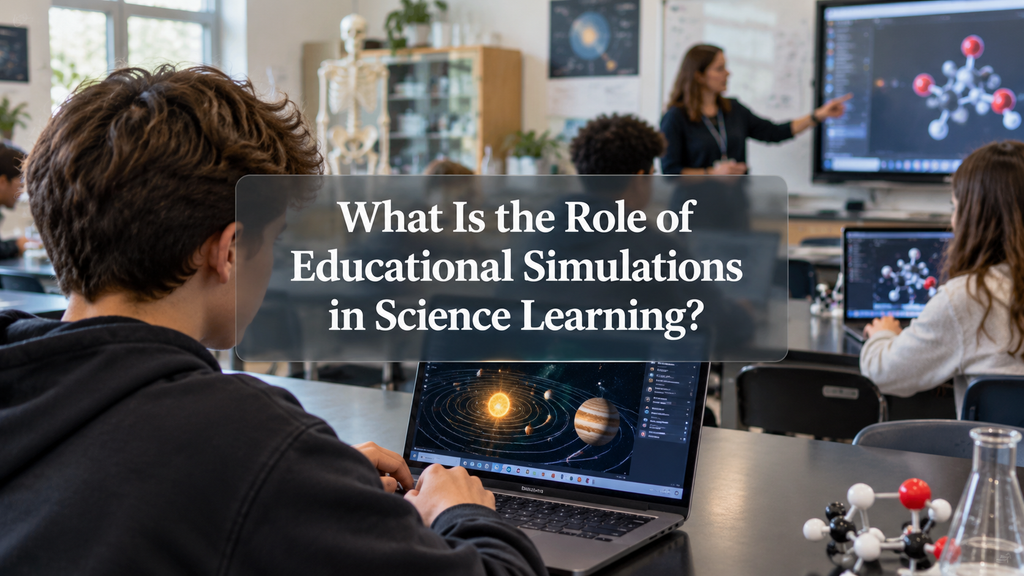
Educational simulations can make these processes easier to explore through visual representations.
For instance, students learning about diffusion can observe animated particles moving from an area of higher concentration toward an area of lower concentration.
They can investigate how temperature or concentration differences affect the process.
Similarly, simulations of the solar system can help learners examine planetary motion and gravitational relationships.
These representations make abstract concepts more accessible.
Teachers should also explain that simulations are simplified models rather than exact copies of reality.
Understanding this distinction helps students develop accurate scientific knowledge.
7. Allowing Students to Learn at Their Own Pace
Students have different learning abilities, interests, and levels of scientific understanding.
Some students understand a concept after one explanation, while others need additional examples and practice.
Educational simulations can support these differences by allowing learners to control their learning experience.
Students may pause an activity, repeat an experiment, or change the speed of a demonstration.
For example, a learner studying the human digestive system might review each stage several times before moving to the next topic.
This flexibility can reduce pressure and allow students to focus on concepts they find challenging.
Teachers can also recommend specific simulation activities according to individual learning needs.
As a result, educational simulations can contribute to a more flexible and inclusive science learning environment.
8. Connecting Scientific Theory With Practical Applications
Scientific theories become easier to understand when students recognize their connection to everyday life.
Educational simulations can demonstrate how scientific principles influence familiar situations.
For example, students learning about heat transfer can examine how different materials affect the movement of thermal energy.
They may connect these observations to cooking utensils, building insulation, and household appliances.
A simulation involving renewable energy might allow learners to investigate how sunlight intensity affects electricity production from solar panels.
Such activities show that science is not limited to textbooks and examinations.
It is connected to technology, environmental protection, transportation, health, and many other parts of daily life.
These practical connections can help students appreciate the relevance of scientific knowledge.
9. Developing Scientific Observation and Analysis Skills
Observation is one of the foundations of scientific investigation.
Students need to recognize patterns, record information, and identify relationships between different factors.
Educational simulations provide controlled environments where learners can practice these abilities.
For example, a simulation involving ecosystems may show how changes in the population of one species affect other organisms.
Students can observe population trends, record results, and compare different conditions.
They can also create tables or graphs using the information collected.
This helps students understand how scientific evidence is organized and interpreted.
Teachers can strengthen these activities by asking students to explain their observations and support conclusions with evidence.
Through repeated practice, learners become more familiar with the methods used in scientific investigations.
10. Making Science Learning More Interesting
Students are often more motivated when learning activities involve discovery and meaningful participation.
Educational simulations can make science lessons more engaging through interactive experiments and visual demonstrations.
For example, a simulation involving space exploration might allow students to examine how gravity affects the movement of spacecraft.
This experience may encourage questions about astronomy, planetary science, and space technology.
Similarly, students exploring a virtual ecosystem may become interested in environmental conservation.
However, an attractive simulation does not automatically guarantee effective learning.
The activity must have clear educational objectives and provide accurate scientific explanations.
When teachers select appropriate simulations, the interactive experience can help maintain student interest while supporting academic understanding.
11. Supporting Teachers in Classroom Instruction
Educational simulations are useful for teachers as well as students.
They provide additional ways to explain scientific concepts and demonstrate experiments.
Teachers can use simulations during classroom discussions, group activities, homework assignments, and revision sessions.
For example, before teaching a lesson about electrical resistance, a teacher can demonstrate how changing resistance affects current in a virtual circuit.
Students can make predictions before observing the results.
The teacher can then explain the scientific principles involved and address common misunderstandings.
Simulations can also help teachers assess student understanding by asking learners to explain what happened during an activity.
When integrated thoughtfully, these tools can support effective science instruction without replacing the teacher’s role.
12. Encouraging Collaboration and Classroom Discussion
Although educational simulations are often used individually, they can also support collaborative learning.
Teachers can divide students into small groups and assign scientific questions that require investigation.
For example, groups might use a simulation to examine how different environmental conditions affect animal populations.
Each group can test a different variable and present its findings to the class.
Students can compare their observations and discuss possible explanations.
These activities encourage communication, teamwork, and scientific reasoning.
They also help learners understand that scientific knowledge often develops through discussion, evidence sharing, and the evaluation of different ideas.
Collaboration can be particularly valuable when students have different levels of understanding because they can learn from one another.
Examples of Educational Simulations Used in Science Learning
Educational simulations can support many areas of science education.
Physics Simulations
Physics simulations help students explore forces, energy, electricity, sound, light, and motion.
Students can investigate how objects move, how circuits function, and how different variables influence physical systems.
Chemistry Simulations
Chemistry simulations demonstrate chemical reactions, molecular structures, solutions, and changes in matter.
They allow students to investigate scientific relationships without always requiring laboratory chemicals.
Biology Simulations
Biology simulations can represent cell structures, human organs, genetics, ecosystems, and biological processes.
Students can explore systems that are difficult to observe directly.
Earth and Space Science Simulations
These simulations help learners investigate weather patterns, earthquakes, planetary movements, and environmental changes.
They provide visual explanations of processes that occur across large distances or long periods.
One well known source of interactive science simulations is PhET Interactive Simulations, developed at the University of Colorado Boulder. It offers educational activities across several scientific subjects.
The most suitable simulation depends on the lesson objectives, student age, and available technology.
What Are the Limitations of Educational Simulations?
Despite their benefits, educational simulations have several limitations that teachers and students should understand.
First, simulations depend on access to suitable digital devices and, in some cases, reliable internet connections.
Schools with limited technological resources may find it difficult to provide equal access.
Second, virtual experiments cannot reproduce every detail of real scientific investigations.
Some simulations simplify scientific processes to make them easier to understand.
This can be helpful for beginners, but students must recognize that real experiments may produce more complicated results.
Third, students may focus on interactive features without paying enough attention to the scientific concepts.
Teachers therefore need to provide clear instructions and meaningful learning objectives.
Finally, simulations cannot fully replace practical laboratory skills.
Measuring substances, handling equipment, recording unexpected observations, and following safety procedures remain important parts of science education.
For these reasons, educational simulations are most valuable when used alongside textbooks, classroom teaching, and physical experiments.
How Can Teachers Use Educational Simulations Effectively?
Teachers can improve the educational value of simulations by planning activities carefully.
Before introducing a simulation, they should explain the scientific concept and identify what students are expected to learn.
Students should also understand how to use the digital tool.
During the activity, teachers can encourage learners to predict outcomes before changing variables.
For example, students investigating a virtual pendulum could predict what happens when its length changes.
After observing the results, they should compare their findings with their original predictions.
Teachers can then organize discussions to explain the underlying scientific relationships.
Short written reflections can also help students remember what they discovered.
Most importantly, teachers should select simulations that are scientifically accurate, appropriate for the students’ educational level, and connected to the curriculum.
The Future of Educational Simulations in Science Education
Educational technology continues to create new opportunities for interactive science learning.
Developments in virtual reality, augmented reality, and computer modeling may make future simulations more immersive and flexible.
Students may be able to explore detailed virtual laboratories, examine biological structures, or investigate scientific environments that would otherwise be difficult to access.
These technologies could also support distance learning by providing additional opportunities for scientific exploration outside traditional classrooms.
However, their success will depend on thoughtful teaching methods, accessible resources, and careful evaluation of educational quality.
Technology should support scientific understanding rather than become the main focus of instruction.
The most effective learning experiences will continue to combine digital exploration with discussion, critical thinking, and practical investigation.
Frequently Asked Questions
What is the main purpose of educational simulations in science?
The main purpose of educational simulations is to help students understand scientific concepts through interactive models and experiments. They allow learners to observe processes, change variables, and investigate relationships.
Can educational simulations replace science laboratories?
Educational simulations can support laboratory preparation and help demonstrate experiments that are difficult or unsafe to perform. However, they cannot completely replace physical laboratories because students also need practical experience with real equipment and materials.
How do simulations improve student understanding?
Simulations can improve understanding by presenting scientific processes visually and allowing students to test ideas. They help connect theoretical explanations with observable outcomes.
Are educational simulations suitable for younger students?
Yes, educational simulations can benefit younger students when the activities are age appropriate and easy to use. Teacher guidance is important to ensure that learners understand the scientific concepts being demonstrated.
Which science subjects benefit from educational simulations?
Physics, chemistry, biology, environmental science, and Earth and space science can all benefit from educational simulations. Their usefulness depends on the topic, learning objectives, and quality of the simulation.
Conclusion
Educational simulations play an important role in science learning by helping students explore complex concepts through interactive experiences. They make invisible processes easier to understand, encourage active participation, and provide opportunities for scientific experimentation in controlled environments.
These tools can also support problem solving, observation, collaboration, and independent learning. By allowing students to change variables and examine results, educational simulations help connect scientific theories with practical understanding.
However, simulations should be viewed as learning resources rather than complete replacements for traditional science education. Classroom explanations, textbooks, teacher guidance, and physical laboratory activities remain essential.
When educational simulations are used with clear objectives and appropriate teaching methods, they can make science education more accessible, engaging, and meaningful. Their greatest value lies in helping students move beyond memorizing scientific facts toward understanding how scientific ideas work in the real world.