
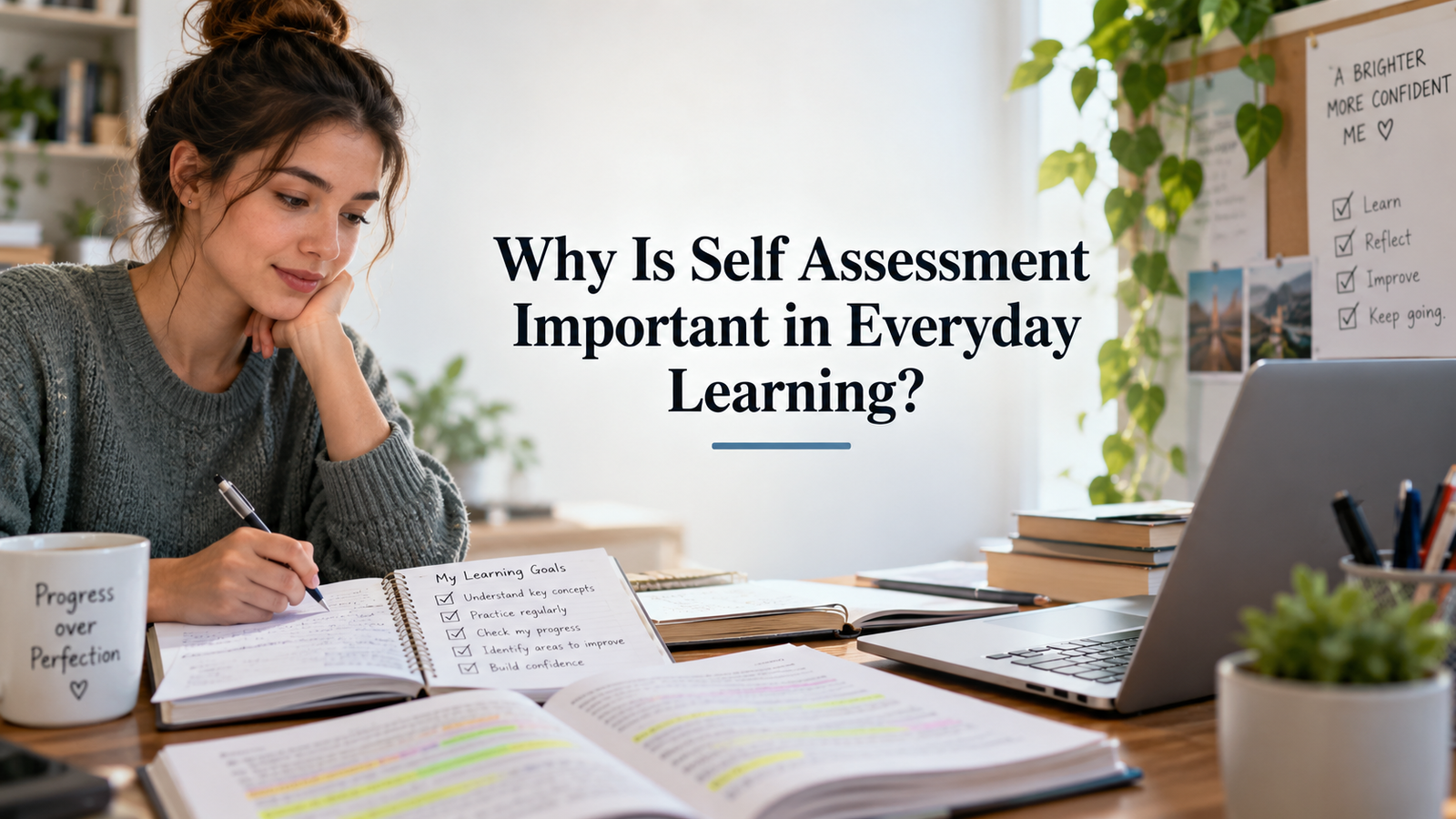
Learning is a continuous process that takes place throughout our lives. We learn new things at school, at work, at home, and through our daily experiences. However, simply reading books, attending classes, or completing assignments does not always mean that we have understood everything correctly. Sometimes, we need to examine our knowledge and identify areas where improvement is necessary. This is where self assessment becomes an important part of everyday learning.
Self assessment helps learners understand their strengths, recognize weaknesses, and measure personal progress. It encourages students to think carefully about what they have learned and how they can improve their learning methods.
When I think about effective learning, I realize that checking our own understanding is just as important as gaining new information. A person who regularly evaluates their learning can make better decisions about study habits, learning goals, and personal development.
In this article, we will explore why self assessment is important in everyday learning, how it benefits students, and how anyone can develop better self assessment habits.
What Is Self Assessment in Learning?
Self assessment is the process of evaluating your own knowledge, skills, understanding, and learning progress. It involves asking yourself questions about what you know, what you have achieved, and what still requires improvement.
For example, a student who finishes reading a chapter can close the book and try to explain the main ideas without looking at the pages. If the student remembers the important information and explains it correctly, this suggests that learning has taken place.
However, if certain concepts are difficult to explain, the student can return to those sections for further study.
Self assessment does not always require formal tests or written examinations. It can involve simple activities such as reviewing notes, answering practice questions, explaining concepts, or reflecting on daily learning experiences.
The main purpose is to understand your current learning level and identify practical ways to improve.
Why Is Self Assessment Important in Everyday Learning?
Self assessment is important because it allows learners to take responsibility for their own educational progress. Instead of depending entirely on teachers, examinations, or external feedback, students can actively monitor their understanding.
Every learner has different abilities, interests, and challenges. Some students understand mathematical concepts quickly, while others perform better in reading, writing, or creative activities.
Through regular self assessment, learners can discover which subjects require additional attention and which learning methods produce better results.
It also helps students develop independence. They gradually become more confident in making decisions about their studies.
Most importantly, self assessment makes learning more meaningful because students begin to focus on understanding information rather than simply completing tasks.
1. Helps Students Identify Their Strengths
One of the biggest benefits of self assessment is that it helps students recognize their strengths.
Every student has certain abilities that make learning easier in particular subjects. Some may have strong reading skills, while others may be good at solving problems or remembering important facts.
When students evaluate their performance regularly, they begin to notice these strengths.
For example, a student preparing for an English examination may discover that reading comprehension is easier than grammar exercises.
This information helps the student understand which skills are already developing well.
Recognizing strengths also builds confidence. Students who understand their abilities are often more willing to participate in classroom discussions and attempt challenging activities.
However, identifying strengths should not mean ignoring other subjects. Instead, it provides a balanced understanding of personal learning abilities.
2. Makes Learning Weaknesses Easier to Understand
Another important advantage of self assessment is identifying learning difficulties.
Students sometimes continue studying without realizing which concepts they do not fully understand.
This can create problems when they attempt more advanced lessons.
Regular self assessment helps learners discover these difficulties before they become larger obstacles.
For example, a student studying mathematics may understand addition and subtraction but struggle with fractions.
By completing practice questions and checking the answers, the student can identify the exact topic that needs improvement.
Instead of repeating the entire chapter, the student can concentrate on fractions.
This approach makes studying more focused and helps learners use their time more effectively.
Understanding weaknesses is not a sign of failure. It is an opportunity to improve through better preparation and consistent practice.
3. Encourages Independent Learning
Independent learning is an important skill for students and adults.
It means taking responsibility for gaining knowledge without depending completely on instructions from other people.
Self assessment supports independent learning because students learn to monitor their own progress.
They begin asking useful questions such as:
- What have I learned today?
- Can I explain this topic in my own words?
- Which part of the lesson was difficult?
- What should I practice tomorrow?
- How can I improve my understanding?
These questions encourage learners to think actively about their education.
Over time, students become more comfortable organizing their studies, choosing learning materials, and solving problems independently.
Independent learning is especially useful when students enter higher education or begin professional careers, where continuous personal development becomes necessary.
4. Improves Confidence and Motivation
Confidence plays an important role in successful learning.
Students who constantly struggle without recognizing their progress may begin to feel discouraged.
Self assessment helps learners notice small improvements that might otherwise go unnoticed.
For example, a student learning English vocabulary may initially remember only five words from a list of twenty.
After regular practice, the student may remember fifteen words correctly.
By comparing the results, the learner can clearly see improvement.
This progress creates motivation to continue studying.
Self assessment also helps students develop realistic expectations. They understand that learning requires time, effort, and repeated practice.
When learners recognize steady improvement, they often become more confident about attempting difficult topics.
5. Helps Students Set Realistic Learning Goals
Setting goals gives learning a clear direction.
However, goals are most useful when they match a learner’s current abilities and available time.
Self assessment provides the information needed to establish realistic learning goals.
For example, a student who struggles with reading comprehension might decide to read one short article every day and summarize its main ideas.
After one week, the student can evaluate whether the activity has improved understanding.
If progress is visible, the same practice can continue. If difficulties remain, the student can adjust the method.
This process connects learning goals with actual performance.
Realistic goals also make studying more manageable because students focus on achievable improvements rather than expecting immediate perfection.
6. Develops Critical Thinking Skills
Critical thinking involves examining information carefully, asking questions, and making reasonable judgments.
Self assessment encourages critical thinking because learners must evaluate their own answers and learning methods.
Instead of simply accepting that an answer is correct, students begin to consider why it is correct.
They also examine mistakes to understand what caused them.
For example, after completing a science assignment, a student can review each answer and compare the explanation with the concepts presented in the textbook.
If an answer is incorrect, the student can investigate the misunderstanding.
This activity encourages deeper thinking and helps learners connect ideas.
As students become more comfortable evaluating information, they may also improve their ability to solve unfamiliar problems.

7. Improves Memory and Understanding
Remembering information is an important part of education, but meaningful learning requires more than memorization.
Self assessment can improve memory when students actively recall information without immediately checking their books.
For example, after studying a history lesson, a student can write down the important events from memory.
The student can then compare the written explanation with the textbook to identify missing information.
This method helps reveal which facts are remembered and which require additional practice.
Explaining a topic in simple words can also support understanding.
If a learner cannot explain an idea clearly, it may indicate that further study is needed.
Regular practice with self assessment can make revision more purposeful and help students retain important information.
8. Encourages Better Time Management
Many students spend several hours studying but do not always achieve the results they expect.
One possible reason is that they divide their time equally among topics, even when some subjects require more attention.
Self assessment helps students understand where their time is most needed.
For example, a student preparing for three examinations may discover that mathematics requires more practice than English or general science.
The student can then adjust the study schedule accordingly.
This does not mean ignoring stronger subjects. It means distributing time according to actual learning needs.
A well organized study routine can reduce unnecessary repetition and make daily learning more productive.
9. Helps Learners Recognize and Correct Mistakes
Mistakes are a natural part of learning.
Every student makes errors while solving questions, writing essays, or understanding new concepts.
What matters most is how those mistakes are handled.
Self assessment encourages learners to review errors instead of ignoring them.
For example, a student writing an English paragraph may notice repeated mistakes involving verb tenses.
By identifying the pattern, the student can practice the relevant grammar rules.
This approach is more effective than correcting individual mistakes without understanding their causes.
Learning from errors also encourages patience.
Students begin to realize that improvement often happens through practice, reflection, and correction.
10. Supports Lifelong Learning
Learning does not end when a person completes school or university.
Adults continue learning through professional responsibilities, personal interests, and everyday experiences.
Self assessment remains valuable throughout life because it encourages continuous improvement.
For example, a person learning computer skills can evaluate progress by completing practical tasks without assistance.
Someone learning a new language can assess speaking ability by recording short conversations and reviewing pronunciation or vocabulary.
Similarly, an employee developing communication skills can reflect on presentations and identify areas for improvement.
These examples show that self assessment is useful beyond traditional education.
It helps individuals remain adaptable and willing to learn new skills.
How Can Students Practice Self Assessment Every Day?
Self assessment does not need to be complicated or time consuming.
Students can include simple evaluation activities in their regular study routines.
One useful method is reviewing the day’s lessons before going to sleep. Learners can think about the important concepts they studied and identify anything they did not understand.
Another method is keeping a learning journal.
Students can write a few sentences about what they learned, what they found difficult, and what they want to improve.
Practice questions are also valuable because they provide opportunities to check understanding.
Students can attempt questions without using textbooks and then review the answers carefully.
Explaining a topic to another person is another practical approach. Teaching an idea often reveals whether the learner understands it clearly.
These activities encourage regular reflection without creating unnecessary pressure.
What Are Some Common Self Assessment Mistakes?
Although self assessment offers many benefits, students should avoid certain mistakes.
One common mistake is judging personal ability too harshly.
Some students focus only on incorrect answers and ignore their achievements. This can reduce motivation.
Another mistake is assuming that familiarity with a topic means complete understanding.
Reading the same chapter several times may create confidence, but answering questions without looking at the book provides a clearer indication of knowledge.
Students should also avoid comparing their progress constantly with classmates.
Every learner develops skills at a different pace.
A better approach is comparing current performance with previous results.
Self assessment works best when learners remain objective, patient, and willing to improve.
What Is the Role of Teachers in Self Assessment?
Teachers play an important role in helping students develop effective self assessment habits.
They can encourage learners to reflect on classroom activities, review assignments, and identify personal learning goals.
Teachers can also provide clear assessment criteria so students understand what good performance looks like.
For example, before submitting an essay, students can review whether their writing has a clear introduction, relevant supporting ideas, correct grammar, and a meaningful conclusion.
Teachers can then provide feedback that helps students compare their own evaluation with an experienced perspective.
This combination of self assessment and teacher feedback creates a more balanced learning experience.
It also teaches students that evaluating their work is a skill that develops through practice.
How Often Should Students Assess Their Learning?
Self assessment can be practiced daily, weekly, or after completing an important topic.
A short daily review is useful for checking immediate understanding.
Weekly assessment helps students observe progress over a longer period.
After completing a chapter, learners can attempt practice questions to determine whether they are ready to move forward.
The ideal frequency depends on the subject, learning goals, and available time.
The most important factor is consistency.
Even a few minutes of thoughtful reflection can provide useful information when practiced regularly.
Conclusion
Self assessment is an essential part of everyday learning because it helps students understand their abilities, recognize challenges, and make informed decisions about their education.
It encourages independent learning, improves confidence, supports better time management, and develops critical thinking skills.
Most importantly, self assessment reminds learners that education is not simply about completing lessons or achieving examination results. It is about developing knowledge, improving understanding, and becoming more capable over time.
From my understanding of effective study habits, regular reflection can make a meaningful difference in how students approach learning. When learners take time to examine their progress, they become more aware of what works and what needs improvement.
By practicing simple self assessment activities every day, students can develop stronger learning habits and prepare themselves for lifelong personal and educational growth.