
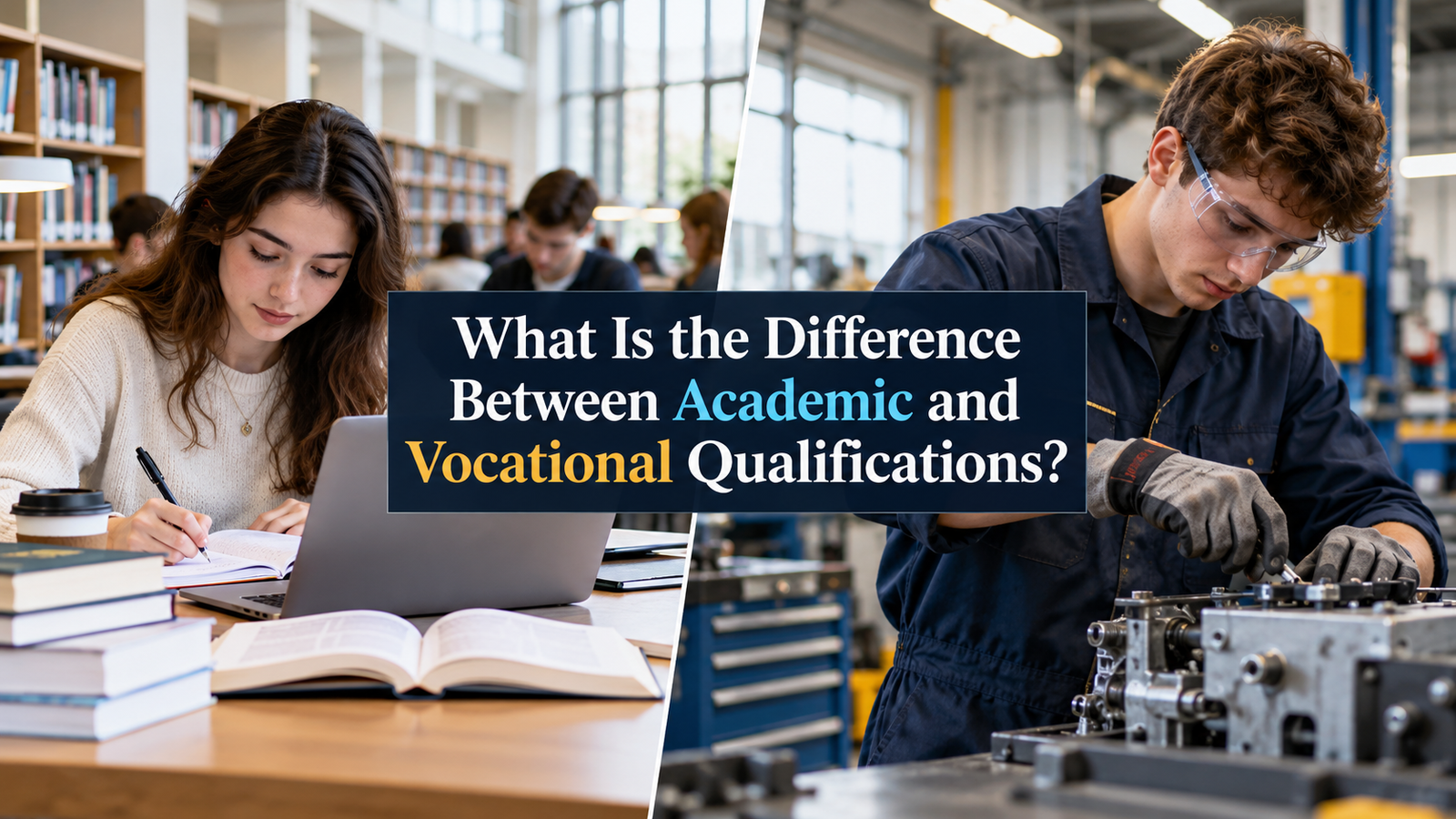
Education is one of the most important foundations for building a successful future. It helps people develop knowledge, improve their abilities, and prepare for different career opportunities. However, not every student follows the same educational pathway. Some students prefer studying theories, exploring subjects, and earning university degrees, while others are more interested in learning practical skills that prepare them for specific jobs.
This is where understanding the difference between academic and vocational qualifications becomes important. Both types of qualifications offer valuable learning experiences, but they differ in their teaching methods, educational goals, assessment systems, and career opportunities.
Academic qualifications generally focus on theoretical knowledge, research, and intellectual development. Vocational qualifications concentrate on practical training, technical abilities, and preparation for particular occupations.
Choosing between these educational pathways depends on personal interests, career ambitions, learning preferences, and future employment goals.
This article explains academic and vocational qualifications, their major differences, advantages, career opportunities, and important factors students should consider before making an educational decision.
What Are Academic Qualifications?
Academic qualifications are educational credentials awarded after completing a structured program focused on theoretical knowledge and subject understanding.
These qualifications are commonly offered by schools, colleges, and universities. Academic education encourages students to develop analytical thinking, communication abilities, research skills, and a deeper understanding of different subjects.
Students following academic programs usually spend considerable time attending lectures, reading textbooks, completing assignments, and preparing for examinations.
Common examples of academic qualifications include secondary school certificates, higher secondary qualifications, bachelor’s degrees, master’s degrees, and doctoral degrees.
For example, a student studying mathematics at university learns mathematical principles, theories, and methods of solving complex problems. Similarly, students studying history explore historical events, social developments, and different interpretations of the past.
Academic qualifications are especially useful for careers that require advanced subject knowledge, formal university education, or professional research.
However, academic education is not limited to classroom theory. Many academic programs also include laboratory activities, internships, fieldwork, and practical projects.
What Are Vocational Qualifications?
Vocational qualifications are educational credentials designed to prepare individuals for particular occupations through practical learning and technical training.
Unlike traditional academic programs, vocational education places greater emphasis on developing abilities that can be applied directly in workplaces.
Students usually learn through workshops, demonstrations, supervised practice, practical assignments, and workplace training.
Vocational qualifications are available through technical institutes, training centers, community colleges, and specialized educational organizations.
Common vocational fields include electrical installation, plumbing, automotive technology, culinary arts, welding, graphic design, beauty services, and hospitality.
For example, a student completing an automotive technology program learns how vehicle engines operate, how to identify mechanical problems, and how to perform maintenance procedures.
Similarly, someone studying culinary arts develops food preparation techniques, kitchen management skills, and knowledge of food safety.
The main purpose of vocational education is to help students become capable of performing specific professional tasks.
Major Differences Between Academic and Vocational Qualifications
Although academic and vocational qualifications both contribute to education and career development, several important differences distinguish them.
1. Educational Focus
The most noticeable difference between academic and vocational qualifications is their educational focus.
Academic education emphasizes theoretical understanding, critical thinking, and broad subject knowledge.
Students explore concepts, examine evidence, and develop the ability to understand complicated ideas.
Vocational education emphasizes practical knowledge and occupational skills.
Students concentrate on learning how to complete particular tasks accurately, efficiently, and safely.
For example, a student studying engineering at university may examine mathematical models, scientific theories, and engineering design principles.
A student receiving vocational training in electrical installation may concentrate on installing wiring systems, identifying electrical faults, and following safety procedures.
Both pathways provide important knowledge, but their immediate educational objectives are different.
2. Teaching and Learning Methods
Academic programs commonly use classroom lectures, textbooks, presentations, research activities, and written assignments.
Teachers encourage students to discuss ideas, evaluate information, and develop independent opinions.
Vocational programs generally include more practical demonstrations, workshops, equipment training, and supervised activities.
Students learn by observing experienced instructors and performing tasks themselves.
For example, students in an academic business management program may study organizational theories and marketing strategies.
Students receiving vocational training in hospitality may practice customer service, food handling, and hotel operations.
These learning methods reflect the different purposes of academic and vocational education.
3. Duration of Study
The time required to complete a qualification can also vary.
Many academic degree programs take several years to complete. A bachelor’s degree commonly requires three or four years, depending on the country and educational system.
Advanced academic qualifications may require additional years of study.
Vocational programs often provide shorter routes into particular occupations.
Some vocational certificates can be completed within several months, while technical diplomas and apprenticeships may require multiple years.
However, vocational qualifications are not always shorter than academic qualifications.
The duration depends on the occupation, qualification level, training requirements, and educational institution.
Students should compare the actual program duration instead of assuming that one pathway is always faster.
4. Assessment Methods
Academic qualifications frequently assess students through written examinations, essays, research papers, presentations, and academic projects.
These assessments measure subject knowledge, reasoning abilities, and understanding of theoretical concepts.
Vocational qualifications often use practical demonstrations, workplace observations, skills assessments, and completed projects.
For example, an academic student might explain the principles of electrical circuits in a written examination.
A vocational student might demonstrate how to install and test an electrical system under supervision.
Some programs combine written examinations with practical assessments.
The assessment method usually depends on the skills and knowledge that the qualification is designed to measure.
5. Career Preparation
Academic qualifications can prepare students for careers requiring broad knowledge, advanced study, or professional specialization.
Examples include research, education, scientific fields, business analysis, and careers requiring university degrees.
Vocational qualifications generally prepare students for more clearly defined occupational roles.
These may include automotive technicians, electricians, chefs, construction workers, and other skilled professionals.
However, academic and vocational career pathways sometimes overlap.
For example, healthcare, engineering, and information technology include both academic and vocational opportunities.
The qualification required for a particular occupation depends on professional regulations, employer expectations, and national educational standards.
Benefits of Academic Qualifications
Academic qualifications provide several advantages for students interested in developing advanced knowledge and pursuing further education.
Development of Critical Thinking
Academic education encourages students to examine information carefully and develop conclusions based on evidence.
Students learn how to compare different viewpoints, recognize weaknesses in arguments, and solve unfamiliar problems.
These abilities are valuable in education, professional environments, and everyday decision making.
Opportunities for Higher Education
Academic qualifications often provide structured pathways toward advanced educational programs.
For example, students completing bachelor’s degrees may become eligible for master’s programs.
Those interested in research may eventually pursue doctoral studies.
However, admission requirements vary between universities and educational systems.
Broad Career Possibilities
Some academic qualifications develop transferable abilities that can be useful across different industries.
Communication, problem solving, research, and analytical thinking are valuable in many professional roles.
For example, a graduate with a business degree may explore opportunities in marketing, administration, management, or entrepreneurship.
Actual employment opportunities depend on experience, additional skills, and labor market conditions.
Benefits of Vocational Qualifications
Vocational education provides important advantages for students who prefer practical learning and occupation focused training.
Development of Practical Skills
One major benefit of vocational qualifications is the opportunity to develop workplace abilities through repeated practice.
Students gain experience using tools, operating equipment, solving technical problems, and completing professional tasks.
This practical experience can help them understand workplace expectations before beginning employment.
Direct Connection With Employment
Many vocational programs are designed around the skills required in specific industries.
For example, a welding course may teach techniques commonly used in manufacturing and construction.
Similarly, hospitality training may prepare students for responsibilities in restaurants and hotels.
This connection between learning and occupational requirements can support employment readiness.
However, completing vocational training does not automatically guarantee a job.
Opportunities for Self Employment
Vocational qualifications can also support individuals interested in establishing small businesses.
People trained in plumbing, tailoring, electrical services, automotive repair, or beauty services may eventually offer their services independently.
Successful self employment also requires customer service, financial management, communication, and business planning skills.
Academic vs Vocational Qualifications: Which Is More Expensive?
The cost of academic and vocational education depends on several factors, including the institution, country, program duration, and available financial support.
University degree programs may involve tuition fees, textbooks, accommodation, transportation, and other educational expenses.
Vocational programs may have lower overall costs when they are shorter, but some require expensive tools, equipment, materials, or examination fees.
For example, technical programs involving specialized machinery may have substantial training expenses.
Students should calculate the complete cost of education before choosing a program.
They should also investigate scholarships, financial assistance, government training initiatives, and affordable public institutions.
A qualification should be evaluated according to both its educational value and its financial requirements.
Can Vocational Qualifications Lead to University Education?
Yes, vocational qualifications can sometimes provide opportunities for further academic education.
Many educational systems offer pathways that allow students to progress from vocational certificates or diplomas into advanced technical programs or university degrees.
Some institutions recognize previous vocational learning and may award academic credit when relevant requirements are satisfied.
However, these opportunities are not universal.
Admission eligibility depends on the qualification level, accreditation status, university policies, and national education framework.
Students planning to continue their education should confirm whether their vocational qualification is recognized by the institutions they wish to attend.
This can prevent difficulties when applying for advanced programs.
How Do Employers View Academic and Vocational Qualifications?
Employers evaluate qualifications according to the responsibilities and requirements of particular jobs.
For positions involving research, advanced analysis, or regulated professional activities, employers may require specific academic degrees.
For technical positions, employers may place greater emphasis on practical competence, professional training, and relevant experience.
For example, an organization hiring an academic researcher may require an advanced university qualification.
A company hiring an automotive technician may prioritize technical certification and the ability to diagnose vehicle problems.
Many employers also consider communication skills, teamwork, reliability, and willingness to learn.
Therefore, neither qualification type should automatically be considered superior.
The most suitable qualification is the one that meets the requirements of the intended career.
How Can Students Choose Between Academic and Vocational Qualifications?
Choosing the right educational pathway requires careful consideration of personal interests and future goals.
Understand Your Interests
Students should begin by identifying the subjects and activities they genuinely enjoy.
Someone interested in research, scientific explanations, and theoretical discussions may prefer academic education.
A student who enjoys repairing equipment, creating products, or performing technical tasks may find vocational education more satisfying.
Personal interest plays an important role in maintaining motivation.
Consider Your Learning Style
Different students respond better to different learning environments.
Some enjoy reading, writing, attending lectures, and completing research assignments.
Others prefer demonstrations, workshops, and practical activities.
Understanding these preferences can help students choose an educational program that supports their learning.
However, students should remain open to developing both theoretical and practical abilities.
Research Career Requirements
Before selecting a qualification, students should investigate the educational requirements of their preferred occupation.
They can review job advertisements, professional regulations, and admission information from recognized institutions.
For example, someone interested in becoming a university lecturer will usually require advanced academic qualifications.
A student planning to become a skilled electrician may need approved technical training, supervised experience, or professional licensing.
Researching these requirements helps students avoid choosing qualifications that do not match their career goals.
Check Institutional Recognition
Recognition and accreditation are important when selecting academic or vocational programs.
Students should confirm whether the educational institution and qualification are accepted by relevant authorities, employers, or professional organizations.
This is particularly important for students who plan to work abroad or continue their education internationally.
A recognized qualification can support future educational and professional opportunities.
Are Academic Qualifications Better Than Vocational Qualifications?
There is no single answer to this question because the value of a qualification depends on individual circumstances.
Academic qualifications are valuable for students who want to develop advanced theoretical knowledge, conduct research, or enter professions requiring university education.
Vocational qualifications are valuable for individuals seeking practical expertise and preparation for specific occupations.
Both educational pathways contribute to society.
Universities prepare researchers, educators, and professionals, while vocational institutions develop skilled workers who support essential industries and services.
Modern workplaces require a combination of intellectual knowledge, practical abilities, technological understanding, and professional responsibility.
Instead of comparing qualifications according to social status, students should evaluate their relevance to personal ambitions and employment requirements.
The Importance of Combining Academic Knowledge With Practical Skills
Academic and vocational education should not always be viewed as completely separate pathways.
Many successful careers require both theoretical understanding and practical experience.
For example, engineering students benefit from learning scientific principles alongside laboratory work and industry training.
Similarly, vocational students studying automotive technology benefit from understanding mechanical theories as well as practical repair methods.
Internships, apprenticeships, technical workshops, and continuing education can help connect classroom knowledge with workplace experience.
Students who develop both conceptual understanding and practical competence may become better prepared to adapt to changing professional demands.
This combination is particularly valuable as technology continues to influence different industries.
Frequently Asked Questions
What is the main difference between academic and vocational qualifications?
The main difference is that academic qualifications generally emphasize theoretical knowledge, research, and broad subject understanding, while vocational qualifications concentrate on practical skills and preparation for specific occupations.
Are vocational qualifications equal to academic degrees?
Some vocational qualifications are placed at comparable levels within national qualification frameworks, but this does not mean every vocational certificate is equivalent to a university degree. Recognition depends on the qualification and educational system.
Can students find good jobs with vocational qualifications?
Yes. Vocational qualifications can prepare students for skilled employment in industries such as construction, manufacturing, hospitality, automotive services, and technology. Employment outcomes depend on training quality, experience, and market demand.
Is academic education necessary for every career?
No. Many occupations provide entry opportunities through vocational education, apprenticeships, or technical certification. Other professions require particular university degrees and professional licenses.
Can students change from vocational education to academic education?
In some educational systems, students can move between vocational and academic pathways through approved admission arrangements, bridging programs, or recognition of previous learning.
Conclusion
Understanding the difference between academic and vocational qualifications helps students make informed decisions about their education and future careers.
Academic qualifications generally emphasize theoretical knowledge, research, critical thinking, and broader educational development. Vocational qualifications focus on practical abilities, technical training, and preparation for specific occupations.
Both pathways have important advantages and can lead to meaningful professional opportunities.
The best choice depends on a student’s interests, preferred learning methods, financial circumstances, and long term career ambitions.
Students should carefully research available programs, verify institutional recognition, and consider the qualifications required for their desired occupations.
Ultimately, educational success is not determined simply by whether someone chooses an academic or vocational qualification. It depends on how effectively individuals develop their knowledge, improve their skills, and apply what they learn throughout their professional lives.