
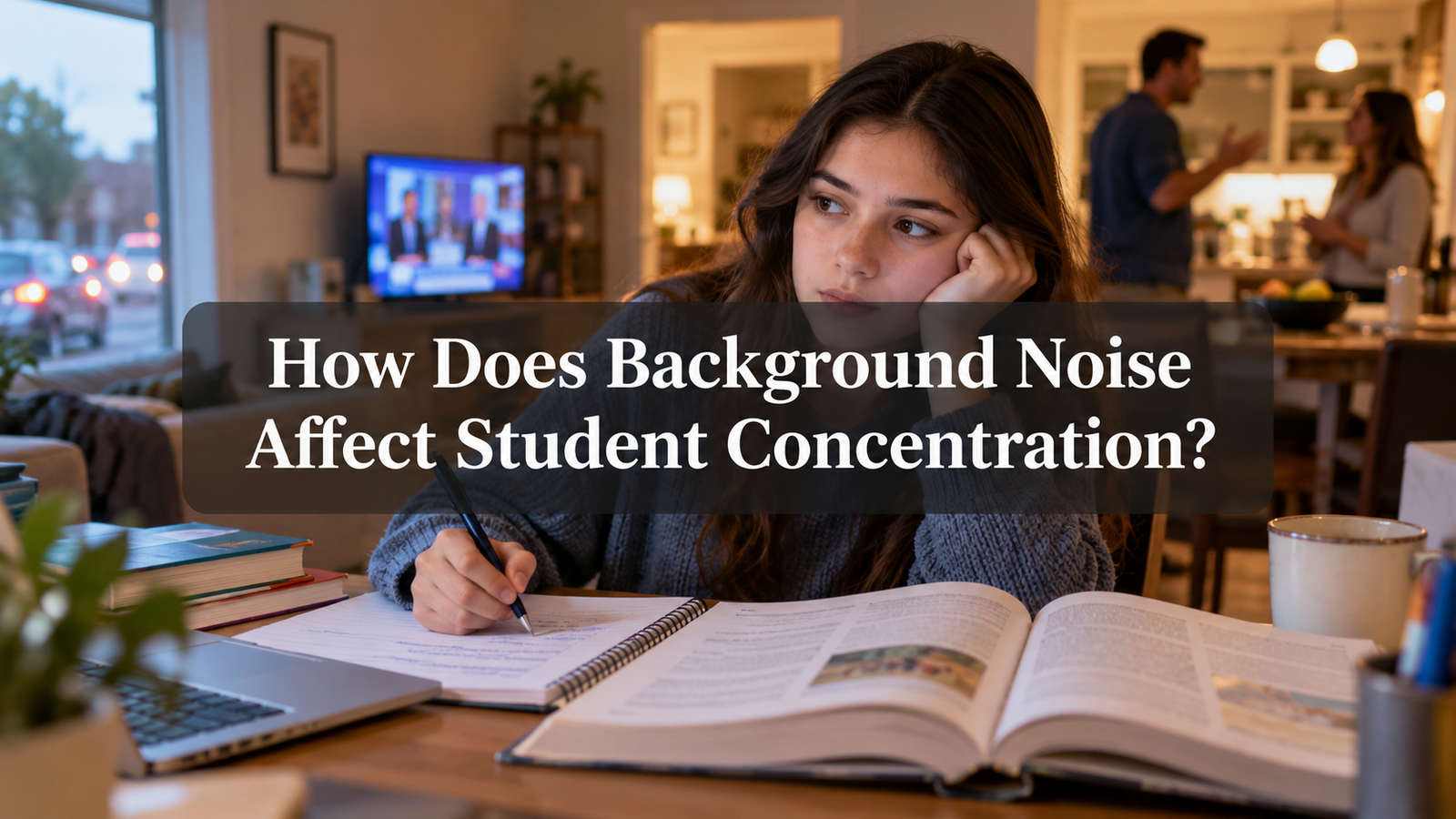
Concentration plays an important role in successful learning. Students need a peaceful environment to understand lessons, remember information, complete assignments, and prepare for examinations. However, finding a completely quiet place to study is not always possible. Many students study at home, in classrooms, libraries, or shared spaces where different sounds can interrupt their attention.
Background noise is one of the common environmental factors that can influence student concentration. It may come from conversations, television, traffic, mobile phones, household activities, or people moving around. Some sounds are easy to ignore, while others make studying more difficult.
Interestingly, background noise does not affect every student in the same way. Some students prefer complete silence, while others feel comfortable studying with soft music or gentle environmental sounds.
Understanding how background noise affects student concentration can help students create better study environments, improve their learning habits, and use their study time more effectively.
What Is Background Noise in a Study Environment?
Background noise refers to sounds that occur around a student while they are studying or completing an academic task. These sounds are usually not directly related to the learning activity.
For example, a student may be reading a textbook while family members are talking in another room. Another student may be solving mathematics problems while traffic sounds enter through an open window.
Common sources of background noise include:
- Conversations between family members or classmates
- Television and radio programs
- Traffic and vehicle horns
- Mobile phone notifications
- Construction and household activities
- Music playing in nearby rooms
- Fans, air conditioners, and other appliances
Not all background sounds are equally distracting. A steady fan sound may become less noticeable after some time, while a sudden loud conversation can immediately interrupt concentration.
The type, volume, and predictability of noise often determine how strongly it affects learning.
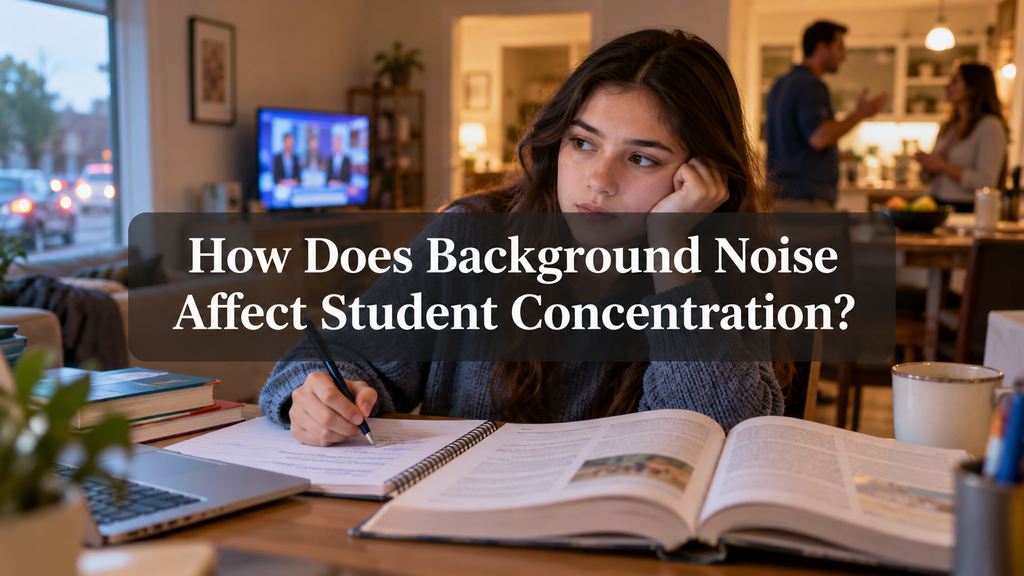
How Does Background Noise Affect Student Concentration?
Background noise affects student concentration by competing for the brain’s attention. When students study, their brains process information from books, teachers, or digital learning materials.
At the same time, the brain continues to notice sounds from the surrounding environment.
If a sound is loud, unexpected, or meaningful, it may attract attention away from the original learning task.
For example, a student reading a science chapter may become distracted when someone nearby starts discussing an interesting topic. Even if the student does not participate in the conversation, understanding the written material may become more difficult.
This happens because attention is limited. When the brain spends additional effort processing irrelevant sounds, fewer mental resources may remain available for studying.
As a result, students may read the same paragraph several times, forget important details, or take longer to complete assignments.
Why Does Noise Make Reading More Difficult?
Reading requires attention, language processing, and understanding. Students must recognize words, connect ideas, and remember information from earlier sentences.
Background conversations can interfere with this process because spoken words may compete with the language being processed during reading.
Imagine a student reading an English literature chapter while another person watches a television drama nearby.
The student may hear dialogue from the television and unintentionally pay attention to it. This interruption can make it harder to follow the meaning of the text.
Noise may also reduce reading speed and comprehension, especially when the material is unfamiliar or complicated.
Students can improve reading concentration by selecting quieter locations and keeping unnecessary conversations away from their study space.
How Does Background Noise Affect Memory?
Memory is essential for learning because students need to retain information and recall it later.
While studying, the brain temporarily holds and processes information through working memory. This mental system has limited capacity.
Distracting sounds can interfere with working memory, particularly during tasks involving words, numbers, or sequences.
For example, memorizing historical dates or learning new vocabulary may become harder when people are talking nearby.
Students may remember fewer details because their attention keeps moving between the learning material and surrounding sounds.
However, the effect depends on the type of noise and the learning activity. Some steady background sounds may have little noticeable impact on simple tasks.
For better memory retention, students should try to minimize distracting sounds when learning difficult concepts or preparing for important examinations.
Can Background Noise Reduce Academic Performance?
Background noise can influence academic performance when it regularly interrupts learning activities.
Students who frequently experience distractions may need additional time to finish homework, revise chapters, or understand complicated lessons.
For example, a student preparing for a mathematics examination needs continuous attention to understand formulas and solve problems correctly.
If loud conversations interrupt the student repeatedly, mistakes may become more likely.
Similarly, students writing essays may lose their train of thought when unexpected sounds interrupt their work.
Research on learning environments suggests that excessive or disruptive noise can affect attention and certain academic tasks.
However, academic performance depends on many factors, including teaching quality, motivation, sleep, study habits, and access to learning resources.
Therefore, background noise should be considered one important factor rather than the only reason behind poor academic results.
Is Complete Silence Always Better for Studying?
Many students believe that complete silence is necessary for effective studying. Although silence can be helpful, it is not always the best option for every person.
Some students concentrate better in quiet libraries where interruptions are limited.
Others feel uncomfortable in completely silent environments and prefer a small amount of consistent background sound.
Individual preferences, previous experiences, and the nature of the task can influence these differences.
For instance, students may prefer silence when memorizing scientific definitions but feel comfortable with soft instrumental music while organizing notebooks.
The most important goal is not necessarily to eliminate every sound. Instead, students should reduce sounds that interfere with their attention.
A suitable study environment allows students to remain focused without constantly noticing what is happening around them.
Does Listening to Music Help Student Concentration?
Music is a popular background sound among students. Many learners listen to music while completing homework, reading, or preparing assignments.
However, music does not always improve concentration.
Soft instrumental music may help some students feel relaxed and comfortable during routine activities.
On the other hand, songs containing lyrics can distract students who are reading, writing, or memorizing information.
This happens because the brain may process the words in the song while simultaneously trying to understand the study material.
Fast music, sudden changes in volume, and favorite songs that encourage singing can also interrupt attention.
Students should experiment carefully with different study conditions to understand what works for them.
If music makes reading slower or increases mistakes, studying without it may be more effective.
How Do Sudden Sounds Affect Attention?
Sudden sounds are often more distracting than steady background noise.
Examples include a ringing phone, a vehicle horn, a door closing loudly, or someone unexpectedly calling a student’s name.
These sounds naturally attract attention because the brain responds to changes in the environment.
Once concentration is interrupted, students may need time to return to their original task.
For example, a student solving a difficult mathematics question may forget the next calculation after hearing a loud interruption.
Repeated interruptions can make studying feel tiring and frustrating.
This is why controlling unnecessary phone notifications and avoiding highly unpredictable environments can improve study efficiency.
Students do not need perfect silence, but reducing unexpected disturbances can make a meaningful difference.
How Does Classroom Noise Affect Learning?
Classrooms are important learning environments where students listen to teachers, participate in discussions, and complete educational activities.
Some classroom noise is natural and useful. Group discussions, presentations, and collaborative activities often involve students speaking to one another.
However, unnecessary noise can make it difficult to understand instructions.
When several students talk while a teacher explains a lesson, others may struggle to hear important information.
Noise can be particularly challenging for younger students, students learning in a second language, and those who experience hearing or attention difficulties.
Teachers can support concentration by establishing clear classroom rules and organizing activities carefully.
Providing quiet periods for reading, writing, and independent practice can also help students remain focused.
The objective should be to manage noise appropriately rather than remove all classroom interaction.
Can Background Noise Increase Stress and Mental Fatigue?
Studying in a noisy environment may require students to make additional efforts to maintain concentration.
Over time, this extra effort can become mentally tiring.
For example, a student preparing for an examination in a crowded household may constantly struggle to ignore conversations, television sounds, and other activities.
This situation can create frustration and make studying feel more difficult than necessary.
Excessive noise may also contribute to stress, especially when students cannot control their surroundings.
However, occasional background sounds do not automatically cause stress or academic difficulties.
The frequency, intensity, and personal experience of noise all matter.
Taking regular study breaks, choosing a comfortable location, and communicating with family members about quiet study periods can help reduce unnecessary pressure.
How Can Students Create a Quiet Study Environment?
A suitable study environment does not require expensive furniture or a separate study room.
Even small changes can reduce distractions and support concentration.
Students can begin by selecting a location away from television, busy entrances, or regular household conversations.
Closing doors and windows, when practical and safe, may reduce outside noise.
Another useful strategy is establishing a regular study schedule. When family members know that a student studies at a particular time, they may be more willing to avoid unnecessary interruptions.
Keeping mobile phones silent can also reduce sudden distractions.
Students sharing a room can arrange quiet study periods with siblings or roommates.
A clean desk, comfortable chair, and adequate lighting can further support concentration by making the study environment easier to use.
The aim is to create a place where attention can remain on learning rather than surrounding activities.
Are Headphones Helpful for Studying in Noisy Places?
Headphones can be useful when students cannot easily control environmental noise.
Noise reducing headphones may lower certain background sounds, especially steady noises such as fans or traffic.
However, they do not eliminate every sound, and their effectiveness varies.
Some students use headphones to listen to instrumental music or consistent environmental sounds.
Others prefer using them without music.
Headphones should be used at comfortable volume levels to protect hearing.
Students should also remain aware of important announcements and safety information, particularly when studying in public places.
Although headphones can support concentration, they are not a complete solution for every noisy environment.
Why Should Students Match Their Study Tasks With Their Environment?
Different learning activities require different levels of attention.
Memorizing vocabulary, understanding scientific explanations, and solving complicated mathematical problems often demand focused mental effort.
These tasks may be easier in quiet surroundings.
Meanwhile, simpler activities such as arranging books, organizing study materials, or reviewing an already familiar schedule may be less affected by moderate background noise.
Students can improve their study planning by completing demanding tasks during quieter periods.
For example, early morning or late evening may offer fewer household distractions, depending on the family’s routine.
Simple tasks can be completed when the environment is busier.
This approach helps students use available study time more effectively without expecting every study session to take place in perfect silence.
How Can Students Identify Their Ideal Noise Level?
Every student can benefit from understanding how different environments affect personal concentration.
A simple way to explore this is by studying similar material under different conditions.
Students might read one chapter in silence and another comparable chapter with soft background music.
Afterward, they can test how much information they remember.
They can also observe how long assignments take and whether they make more mistakes in certain environments.
For meaningful comparisons, students should consider differences in task difficulty, energy levels, and previous knowledge.
Rather than relying only on personal feelings, checking actual learning results can provide useful information.
If a particular sound consistently reduces understanding, it may be better to avoid it during demanding study sessions.
The goal is to develop practical study habits based on individual learning needs.
What Can Parents and Teachers Do to Reduce Noise Distractions?
Parents and teachers play an important role in creating supportive learning environments.
At home, parents can help by keeping television volume moderate and encouraging family members to respect study periods.
Students who share bedrooms may benefit from an agreed schedule that gives everyone access to quieter study time.
Teachers can help by maintaining classroom routines and ensuring that instructions are clearly heard.
They can also provide designated quiet periods for independent work.
Schools may consider classroom arrangements, door seals, and other practical improvements where excessive external noise is a problem.
Importantly, students should feel comfortable explaining when noise prevents them from understanding lessons.
Cooperation between students, parents, and teachers can make studying easier without requiring unrealistic levels of silence.
Frequently Asked Questions About Background Noise and Student Concentration
Does background noise always distract students?
No. The effect depends on the type and volume of noise, the learning activity, and individual differences. Steady, quiet sounds may have little impact, while conversations and sudden loud noises can be distracting.
Is it better to study with music or in silence?
Silence is often helpful for reading, memorization, and complicated learning tasks. Some students may prefer soft instrumental music during simpler activities. Students should choose the condition that produces better learning results.
Can noise affect students during examinations?
Yes. Unexpected or excessive noise can interrupt attention during examinations, especially when students need to read carefully, remember information, or solve difficult questions.
What is the best way to avoid noise while studying at home?
Choose a relatively quiet location, silence unnecessary phone notifications, establish regular study hours, and ask family members to limit avoidable interruptions.
Can students become accustomed to background noise?
Students may become less aware of familiar, steady sounds over time. However, becoming accustomed to noise does not guarantee that it will have no effect on learning or memory.
Conclusion
Background noise can affect student concentration by interrupting attention, interfering with working memory, and making certain learning activities more difficult. Conversations, television, traffic, music, and unexpected sounds can all influence the quality of a study session.
However, not every sound has the same effect. Some students work best in silence, while others tolerate gentle and consistent background sounds.
Students can improve concentration by identifying distracting noises, choosing suitable study locations, reducing unnecessary interruptions, and matching difficult learning tasks with quieter periods.
Parents and teachers can also support learning by creating environments where students can listen, read, and think without constant disturbances.
Ultimately, understanding how background noise affects student concentration helps students develop better study habits. A comfortable and appropriately quiet learning environment can make it easier to understand lessons, remember information, and complete academic work with greater confidence.